

Business technology innovation in 2026 requires a deliberate approach combining strategic investment in emerging technologies, organizational culture transformation, and measurable outcomes tied to competitive advantage. Canadian organizations that succeed don’t chase every trend. They identify specific business problems, evaluate technology solutions against clear ROI criteria, and build internal capacity to sustain innovation beyond initial deployments.
The difference between productive innovation and expensive experimentation comes down to execution discipline. Companies leading Canada’s technology transformation integrate new tools into existing workflows rather than forcing wholesale disruption. They start with pilot programs that validate assumptions, measure actual productivity gains, and scale only what delivers measurable value. This pragmatic approach matters particularly in the Canadian market, where mid-sized enterprises face capital constraints that demand proof before broader investment.
Three forces are reshaping how Canadian businesses approach technology innovation right now. First, artificial intelligence has moved from experimental to operational, with organizations deploying AI to automate decision-making in supply chain management, customer service, and financial forecasting. Second, cloud-native architectures have become the default infrastructure choice, enabling faster deployment cycles and reducing the technical debt that once locked companies into outdated systems. Third, cybersecurity requirements have evolved from a compliance checkbox to a fundamental design principle, driven by both regulatory pressure and the escalating cost of data breaches.
The Canadian innovation landscape presents unique opportunities and constraints. Federal and provincial programs provide innovation funding and tax incentives that reduce the financial risk of technology adoption. At the same time, competition for technical talent remains intense, particularly in major urban centers, forcing companies to reconsider build-versus-buy decisions and partnership strategies.
What follows is a practical framework for implementing technology innovation that accounts for these realities, supported by case studies from Canadian organizations that have navigated this journey successfully.
The Innovation Imperative: Why Canadian Businesses Must Evolve Now

Canadian businesses face unprecedented pressures to embrace technological transformation, and the timeline for action has compressed dramatically. The confluence of global market dynamics, evolving customer behaviors, and accelerated digitalization has created an environment where standing still equates to falling behind.
Global competition now arrives through digital channels with minimal geographic friction. A Toronto-based retailer competes not just with local stores but with international e-commerce platforms that offer sophisticated personalization, seamless checkout experiences, and same-day delivery. Manufacturing firms in Alberta find themselves bidding against competitors who’ve automated quality control and optimized supply chains through predictive analytics. The competitive advantage once afforded by physical proximity or established relationships erodes when customers can access better service, lower prices, or superior products with a few clicks.
Customer expectations have evolved faster than most organizations anticipated. Post-pandemic consumers and business buyers alike now expect digital-first interactions, real-time responsiveness, and personalized experiences as baseline requirements rather than premium features. A survey request that takes three days to quote loses to a competitor whose automated system provides instant pricing. Clients accustomed to tracking their Amazon package in real-time question why they can’t monitor their B2B order’s production status the same way. These expectations cut across industries and company sizes.
The pandemic served as an unwitting catalyst, compressing a decade of digital transformation into eighteen months. Companies forced to implement remote work capabilities, digital customer engagement, and online service delivery discovered that technological evolution wasn’t as complex or risky as previously assumed. Yet this acceleration also exposed a widening gulf between organizations that embraced change and those that implemented temporary patches. The businesses that treated 2020’s digital shift as a permanent transformation now operate with fundamentally different cost structures, talent access, and market reach than competitors who view remote work and digital channels as necessary evils to be minimized.
What’s genuinely at stake extends beyond market share. Companies delaying technological transformation face talent retention challenges as skilled workers gravitate toward organizations offering modern tools and flexible work environments. They accumulate technical debt as legacy systems become increasingly difficult and expensive to maintain. Perhaps most critically, they forfeit the technology adoption pressures that could inform strategic pivots before market conditions demand them, leaving themselves reactive rather than proactive when disruption inevitably arrives.
Five Technology Domains Reshaping Canadian Enterprise
Artificial Intelligence and Machine Learning Applications

Canadian businesses are moving beyond AI experimentation into practical deployment, particularly in three areas delivering measurable returns. Retail and e-commerce companies use machine learning algorithms to predict inventory needs with 30-40% greater accuracy than traditional forecasting, reducing both stockouts and excess inventory costs. Financial services firms deploy AI-powered fraud detection systems that analyze transaction patterns in real-time, catching suspicious activity human analysts would miss while dramatically reducing false positives that frustrate customers.
Customer service represents the most visible AI application, with chatbots and virtual assistants now handling routine inquiries across sectors. The technology works best when scoped narrowly: answering FAQs, processing simple transactions, or routing complex issues to human agents. Companies that try to automate too much too quickly damage customer relationships rather than improve them.
We expected AI to replace tasks, but discovered it amplifies our team’s capabilities when we focus on augmentation rather than replacement.
Implementation challenges cluster around three persistent issues. Data quality remains the primary barrier; AI systems trained on incomplete or biased historical data produce unreliable outputs. Canadian businesses often underestimate the effort required to clean, organize, and maintain the datasets these systems need. Integration with legacy systems creates technical complexity that extends timelines and inflates costs beyond initial projections.
The talent shortage is real but addressable. Rather than competing for scarce AI specialists, successful companies upskill existing employees to work alongside AI tools, reserving specialist expertise for system design and oversight. Setting realistic expectations matters: AI delivers incremental improvements in efficiency and insight, not overnight transformation. Projects showing 15-20% performance gains within the first year represent genuine success, not disappointment.
Cloud Infrastructure and Hybrid Work Technology
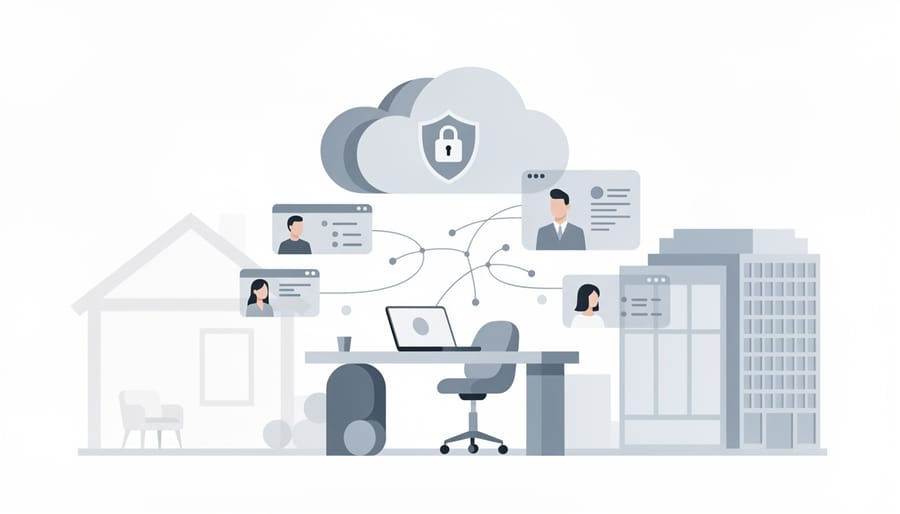
The pandemic accelerated what was already inevitable: Canadian businesses moving critical operations to cloud infrastructure. But this shift isn’t just about remote access anymore. Organizations are discovering that cloud adoption fundamentally changes how they compete, particularly in a country where geography has always posed operational challenges.
Most Canadian enterprises now operate hybrid cloud environments, mixing public cloud services with private infrastructure and on-premises systems. This approach addresses a distinctly Canadian concern, data sovereignty. Federal and provincial privacy laws, including PIPEDA and Quebec’s Law 25, impose stricter requirements than many international cloud providers’ standard offerings. Organizations handling sensitive data must ensure their cloud architecture keeps regulated information within Canadian borders, which often means partnering with providers offering Canadian data centers or implementing hybrid solutions that segregate data by compliance requirements.
The security equation has evolved beyond simple perimeter defense. Cloud security now demands identity management, zero-trust architectures, and continuous monitoring across distributed environments. Canadian businesses face particular vulnerability to ransomware attacks targeting cloud configurations, making proper access controls essential.
Cost management remains the persistent challenge. What appears economical at small scale can balloon as usage grows. Successful organizations treat cloud spending as a strategic resource requiring active governance, tracking consumption, optimizing resource allocation, and rightsizing services to match actual needs rather than projected ones.
Automation and Process Optimization Tools
Canadian businesses are deploying automation across three distinct operational layers, each delivering measurable returns when implemented with clear objectives and workforce engagement.
In manufacturing, robotic process automation has moved beyond assembly lines into quality control and inventory management. A mid-sized Ontario automotive parts supplier reduced defect rates by 34% after implementing vision-guided robots for inspection tasks, while simultaneously redeploying quality control staff to process improvement roles. The technology paid for itself within 18 months through reduced waste and warranty claims.
Service sector automation focuses on customer-facing processes and back-office operations. Insurance companies are using intelligent document processing to handle claims intake, cutting processing time from days to hours. Retail operations employ automated inventory replenishment systems that analyze point-of-sale data, seasonal patterns, and supplier lead times to optimize stock levels without human intervention.
Knowledge work automation targets repetitive cognitive tasks. Finance teams use software bots to reconcile accounts and generate compliance reports. Marketing departments automate campaign performance analysis and lead scoring. These implementations typically show ROI within 12 months through time savings alone.
Success requires treating automation as workforce augmentation rather than replacement. Companies achieving the strongest results involve employees in identifying automation opportunities, provide retraining for higher-value work, and communicate transparently about changing role expectations throughout the transition.
Advanced Data Analytics and Business Intelligence
Canadian businesses are drowning in data but starving for insights. The average mid-sized organization collects terabytes of information across CRM systems, ERP platforms, and customer touchpoints, yet struggles to convert this raw material into strategic decisions that move the business forward.
The transformation happens when companies shift from retrospective reporting to predictive intelligence. Rather than asking “what happened last quarter,” advanced analytics platforms enable questions like “which customer segments are most likely to churn in the next 90 days” or “where should we allocate inventory based on emerging regional demand patterns.”
Modern business intelligence tools have democratized data analysis beyond IT departments. Self-service platforms allow marketing teams to segment audiences in real-time, operations managers to identify bottlenecks before they cascade, and finance leaders to model scenarios without waiting for quarterly reviews.
The gap between collection and insight typically stems from three failures: fragmented data sources that don’t communicate, lack of clear questions driving the analysis, and insufficient investment in the human expertise to interpret results. Technology provides the capability, but strategic clarity determines whether insights actually inform decisions or become another unused dashboard gathering digital dust.
Sustainability Technology and ESG Compliance

Canadian businesses face mounting pressure to demonstrate environmental responsibility, driven by federal carbon pricing mechanisms, provincial emissions regulations, and investor scrutiny of ESG performance. The technology available to track, reduce, and report environmental impact has evolved from basic spreadsheet tracking to sophisticated real-time monitoring systems.
Environmental monitoring technology now provides granular visibility into resource consumption across operations. Smart sensors track energy use at the equipment level, identify waste streams in manufacturing processes, and monitor water consumption patterns. These systems flag inefficiencies that often go unnoticed in traditional reporting cycles, turning compliance documentation into operational optimization opportunities.
Carbon accounting platforms have become essential infrastructure for companies navigating Canada’s carbon pricing framework. Modern solutions integrate directly with utility data, supply chain information, and transportation systems to calculate Scope 1, 2, and 3 emissions with increasing accuracy. The challenge isn’t accessing these tools, it’s establishing the data governance and internal processes to feed them reliable information.
Several technologies are proving particularly valuable for Canadian organizations:
- IoT sensors for real-time emissions monitoring at production facilities
- AI-powered energy management systems that optimize HVAC and lighting based on occupancy and weather
- Blockchain-based supply chain tracking for verifiable sustainability claims
- Digital twins that model environmental impact of operational changes before implementation
- Automated ESG reporting platforms that aggregate data across multiple frameworks
The gap between collecting sustainability data and acting on it remains wide. Many Canadian companies invest in monitoring technology but lack the internal expertise to translate insights into meaningful reduction strategies. Successful implementation requires pairing technology with clear accountability structures and linking environmental performance to business unit goals, not just corporate reporting requirements.
Case Study: Technology Transformation in Action
Loblaws’ food retail division faced mounting pressure in 2024. Online ordering systems couldn’t handle demand spikes, supply chain visibility was minimal, and food waste across their distribution network was costing millions annually. The company’s technology infrastructure, largely built in the early 2010s, couldn’t support the real-time decision-making required in modern retail operations.
The transformation began with a comprehensive audit revealing that disconnected systems prevented data flow between suppliers, warehouses, and stores. Executive leadership committed to a three-year technology overhaul focusing on AI-driven inventory management, IoT sensor networks for cold chain monitoring, and predictive analytics for demand forecasting.
Implementation started small. A pilot program at twelve Toronto-area stores deployed smart shelf sensors and automated replenishment algorithms. The technology tracked product movement in real time, triggering restocking orders when inventory hit preset thresholds. Within six months, the pilot stores reduced stockouts by 34% and cut spoilage by 28%, metrics that justified broader rollout.
The second phase proved more challenging. Integrating legacy point-of-sale systems with new cloud-based analytics platforms required six months of parallel operation and staff retraining. Distribution centre workers initially resisted handheld devices that tracked picking efficiency, viewing them as surveillance tools. Management addressed concerns through transparent communication about performance metrics and involving frontline staff in interface design decisions.
By early 2026, Loblaws had deployed the full technology stack across 200 locations. Measurable outcomes included $47 million in annual waste reduction, 22% improvement in inventory turnover, and 15% increase in customer satisfaction scores related to product availability. The AI system now processes 2.3 million data points daily, predicting regional demand patterns with 87% accuracy.
Beyond grocery retail, similar approaches are transforming other sectors. Innovation in agriculture uses comparable sensor networks and predictive analytics to optimize crop yields and reduce resource waste.
Three lessons emerged from Loblaws’ experience. First, executive commitment must translate into multi-year budget certainty, technology transformation can’t survive annual funding battles. Second, change management matters as much as technical implementation; the best systems fail without user adoption. Third, starting with high-impact pilot projects builds organizational confidence and generates the data needed to refine broader deployment strategies.
The company’s CTO noted that innovation isn’t finished, it’s continuous. Teams now run quarterly sprints testing emerging technologies, from computer vision for automated checkout to blockchain for supply chain transparency.
Overcoming the Innovation Barriers Canadian Businesses Face
Canadian businesses face four primary barriers when pursuing technology innovation, each requiring distinct strategies to overcome. Understanding these obstacles and how innovation works in practice helps leaders develop realistic transformation plans.
Budget constraints top the list for most organizations. The perceived cost of new technology often overshadows its long-term value, particularly when companies calculate only the initial investment rather than total cost of ownership. Finance leaders can reframe this barrier by building business cases that quantify current inefficiencies, using pilot programs to demonstrate ROI before full deployment, and exploring phased implementations that spread costs across multiple fiscal periods. Cloud-based solutions with subscription pricing models have made enterprise-grade technology accessible without massive capital expenditure.
Talent shortages create a second critical bottleneck. Canadian companies struggle to find technology professionals with both technical expertise and business acumen. Rather than competing for scarce specialist talent, successful organizations are upskilling existing employees through structured learning programs, partnering with technology vendors who provide implementation support, and building advisory relationships with consultants for strategic guidance while maintaining internal operational control.
| Barrier | Business Impact | Mitigation Strategy |
|---|---|---|
| Budget Constraints | Delayed adoption, competitive disadvantage | Phased implementation, cloud subscriptions, ROI-focused pilots |
| Talent Shortages | Implementation delays, knowledge gaps | Upskilling programs, vendor partnerships, focused hiring |
| Legacy Systems | Integration complexity, data silos | API middleware, parallel operation periods, gradual migration |
| Organizational Resistance | Low adoption rates, cultural friction | Change champions, early wins communication, inclusive planning |
Legacy system integration presents technical challenges that many leaders underestimate. Decades-old software often lacks modern APIs, creating data silos that undermine new technology investments. Middleware solutions and data integration platforms can bridge these gaps without requiring complete system replacements. Running new and old systems in parallel during transition periods reduces risk while building organizational confidence.
Organizational resistance remains the most underestimated barrier. Technology projects fail most often due to people issues rather than technical ones. Employees fear job displacement, resist workflow changes, and doubt the necessity of new tools. Effective change management starts months before technology deployment, involving end users in planning, identifying internal champions who advocate for change, and communicating early wins that demonstrate tangible benefits to skeptical teams.
Building an Innovation Framework That Works
A sustainable innovation framework begins with clear governance. Establish a cross-functional innovation steering committee that includes representation from IT, operations, finance, and business units. This group sets strategic priorities, allocates resources, and ensures technology initiatives align with business objectives. Define decision-making authority explicitly; innovation often stalls when approval processes remain ambiguous or when too many stakeholders hold veto power.
Investment prioritization requires discipline. Evaluate potential technology projects against three criteria: strategic alignment with core business goals, realistic ROI projections within 18-24 months, and organizational readiness to implement. Canadian mid-market companies often spread resources too thin across multiple initiatives. Concentrate investment on two or three high-impact projects rather than funding ten experiments that lack the support to succeed. Create a transparent scoring system that applies consistent evaluation standards to every proposal.
Pilot programs reduce risk while building organizational capability. Start with contained use cases that address specific pain points rather than attempting enterprise-wide transformation. A manufacturing company might pilot predictive maintenance sensors on one production line before expanding across facilities. Define success metrics before launch, establish a fixed timeline (typically 90-120 days), and commit to making a decision when the pilot concludes. Too many pilots drift indefinitely without progression to full deployment or formal cancellation.
Scaling requires structured methodology. Document what worked during pilots, identify process changes needed for broader rollout, and secure executive sponsorship before expansion. Many promising innovations fail at scale because companies underestimate the change management required. Assign dedicated implementation teams rather than expecting existing staff to absorb additional responsibilities. Building on proven technology venture strategies can accelerate this transition by applying frameworks designed specifically for the Canadian market context.
Review your framework quarterly. Innovation practices must evolve as technology capabilities advance and business conditions shift. What constitutes cutting-edge today becomes table stakes within months.
The Ethics and Responsibility Dimension
Technology innovation without ethical guardrails creates risks that can destroy stakeholder trust and invite regulatory intervention. Canadian businesses face mounting pressure to demonstrate that their technology deployments respect privacy rights, promote fairness, support workforce wellbeing, and minimize environmental harm.
Privacy stands as the most immediate concern. When deploying AI-driven analytics, customer relationship systems, or workplace monitoring tools, companies must navigate PIPEDA requirements and emerging provincial regulations. The question isn’t whether to collect data, but what data is genuinely necessary and how to protect your reputation through transparent handling practices. Organizations that default to maximum data collection rather than purpose-limitation principles create liability while eroding customer confidence.
Algorithmic bias presents a subtler challenge. Machine learning systems trained on historical data can perpetuate discriminatory patterns in hiring, credit decisions, or service delivery. Canadian businesses must audit their AI systems for fairness, particularly when these tools affect employment or customer access. This requires diverse development teams and regular bias testing, not just at launch but throughout the system’s operational life.
Workforce displacement demands honest reckoning. Automation will eliminate certain roles while creating others. Responsible companies invest in reskilling programs before layoffs, engage workers in transition planning, and consider the social impact of their deployment timelines. Treating employees as disposable costs rather than assets worth developing creates reputational damage that extends beyond the workforce.
Environmental impact deserves equal scrutiny. Data centers consume massive energy, AI training runs generate significant carbon footprints, and electronic waste from technology refreshes contributes to landfill problems. Canadian businesses taking idea to enterprise must calculate the environmental cost alongside the business case.
Technology innovation isn’t a destination Canadian businesses can mark complete on a roadmap. The companies reshaping industries today recognize transformation as continuous practice, requiring persistent attention even after initial deployments succeed. Markets evolve, technologies mature, and customer expectations shift faster than any strategic plan can anticipate.
Canadian business leaders now face a choice that will define their organizations’ next decade. Waiting for certainty before investing in AI, cloud infrastructure, or advanced analytics means ceding ground to competitors already extracting value from these tools. Yet rushing into technology adoption without strategic frameworks risks wasted capital and organizational disruption.
The path forward demands balance. Start with targeted pilots addressing specific business problems rather than broad transformation mandates. Build internal capabilities while acknowledging when external expertise accelerates progress. Measure outcomes rigorously but remain patient enough to let innovations mature beyond initial implementation friction.
The ethical dimension cannot be separated from technological advancement. Privacy protections, algorithmic fairness, and workforce transition strategies must shape innovation decisions from the start, not arrive as afterthoughts when problems emerge. Canadian businesses that integrate responsibility into their technology strategies will build sustainable competitive advantages while contributing to broader societal progress.
The innovation imperative is clear. Canadian enterprises that commit to ongoing technological evolution while maintaining operational discipline and ethical standards will thrive. Those treating innovation as optional will find themselves increasingly irrelevant in markets that reward adaptability above legacy advantages.