
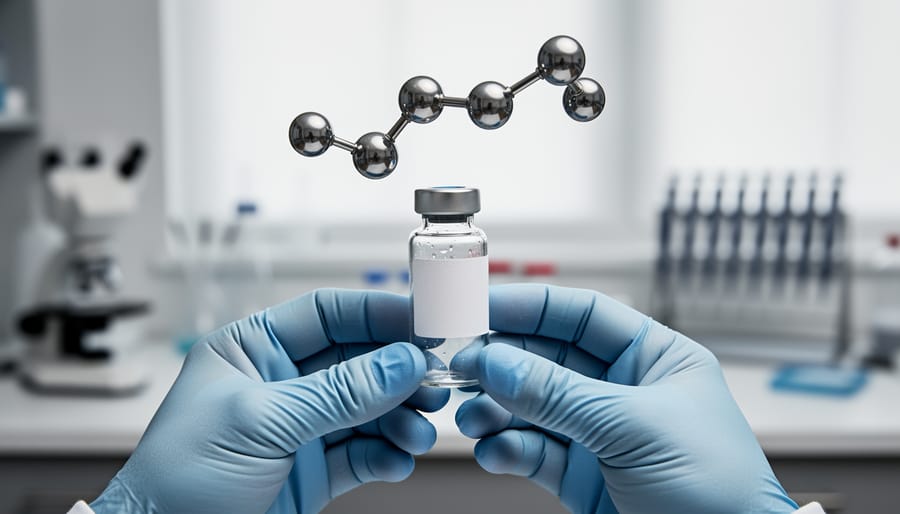
Ipamorelin is a synthetic pentapeptide, a chain of five amino acids, that researchers classify as a growth hormone secretagogue. Anyone looking to buy ipamorelin for laboratory use should know it mimics ghrelin, the body’s “hunger hormone,” and binds to receptors in the pituitary gland, prompting a short, selective release of growth hormone. It doesn’t supply the hormone itself. It signals the body’s own system to produce it.
That distinction matters. Compared with older secretagogues, ipamorelin is studied for its narrow action, with less stimulation of cortisol and prolactin, which is why it keeps surfacing in peptide research literature. For Canadian professionals tracking the growth of Canadian biotech, understanding compounds like this is part of reading where therapeutic innovation is heading.
It’s also a regulated space. Ipamorelin is sold for research purposes only, not as an approved treatment, and Canadian rules and ethical standards apply. This article covers how ipamorelin works, how it compares with related peptides, where it appears in research, and where the regulatory lines sit.
What Ipamorelin Means: A Plain-Language Definition
Ipamorelin is a synthetic pentapeptide, meaning a short chain of five amino acids built in a laboratory rather than extracted from a living source. It was designed to imitate the signalling of ghrelin, a hormone the body uses to stimulate growth hormone release. When ipamorelin binds to the right receptor, it prompts the pituitary gland, a pea-sized structure at the base of the brain, to release growth hormone in natural-looking pulses.
The size of the molecule matters. A peptide sits between a small-molecule drug, which is a compact chemical compound, and a protein, which is a much longer and more complex chain of amino acids. Peptides tend to be highly specific in what they target, but they also tend to break down quickly in the body. That trade-off explains much of the research interest in them.
A few terms come up repeatedly in the literature:
- Peptide
- A short chain of amino acids linked together, smaller than a protein and often acting as a signalling molecule.
- Growth hormone secretagogue
- A substance that prompts the body to release its own growth hormone rather than supplying the hormone directly.
- Ghrelin receptor (GHSR)
- The cell receptor that ghrelin and ghrelin-mimicking peptides such as ipamorelin bind to in order to trigger growth hormone release.
- Half-life
- The time it takes for the concentration of a compound in the body to fall by half, a key measure of how long it remains active.
- Research-use-only
- A label indicating that a material is intended for laboratory investigation, not for human or veterinary use.
Ipamorelin belongs to the family of growth hormone-releasing peptides, alongside compounds such as GHRP-6 and hexarelin. It emerged from pharmaceutical research in the 1990s, when scientists were looking for secretagogues that could stimulate growth hormone with fewer side effects than earlier candidates. Its appeal to researchers today lies largely in that selectivity, along with its usefulness as a tool for studying how the growth hormone system behaves.
How Ipamorelin Works in the Body
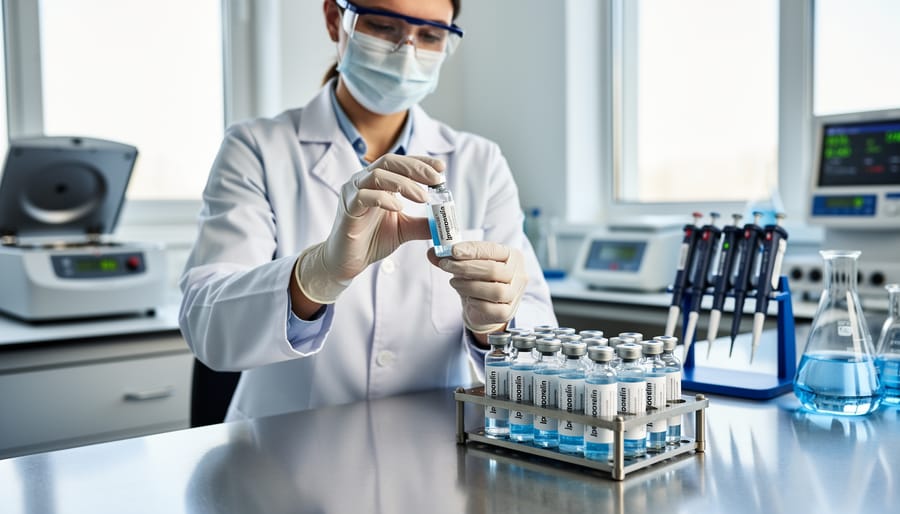
Ipamorelin works by borrowing a signal the body already uses. It binds to the growth hormone secretagogue receptor (GHS-R1a), the same receptor that ghrelin, the so-called “hunger hormone,” activates. Receptors of this type sit on pituitary cells, and when ipamorelin docks with them, the pituitary is prompted to release growth hormone from its own stores.
Timing is the interesting part. The body normally releases growth hormone in pulses, with bursts throughout the day and a larger one during deep sleep, rather than as a steady stream. Researchers have noted that ipamorelin appears to trigger a short, pulse-like release that resembles this natural rhythm. Administering growth hormone itself is a different proposition, because it replaces the hormone directly and can bypass the body’s regulatory feedback loops. Think of it as the difference between sending a message that asks a factory to produce more and simply delivering finished goods to the loading dock.
You will often see ipamorelin described as “selective,” and the label deserves some context. In published studies, earlier growth hormone-releasing peptides such as GHRP-6 and hexarelin also nudged levels of cortisol (a stress hormone) and prolactin. Ipamorelin showed little of that effect at the doses researchers examined, which is why it earned the reputation of being a cleaner tool for studying growth hormone signalling specifically.
That said, selectivity is a finding from a limited body of work, and much of it comes from animal models and small early-stage trials. A narrow hormonal footprint in the lab does not guarantee the same profile across larger or longer-term human studies, and it says nothing about safety or benefit in everyday use. For leaders weighing where this field is heading, the practical takeaway is to treat the mechanism as well-characterized in outline but still thinly validated in the detail, and to read any bolder claim with healthy scepticism.

How Ipamorelin Compares With Related Peptides
Ipamorelin belongs to a wider family of research peptides that act on the growth hormone axis, and the family splits into two camps. Growth hormone-releasing peptides (GHRPs) bind the ghrelin receptor, while growth hormone-releasing hormone (GHRH) analogues act on a separate receptor. Knowing which camp a compound sits in explains most of the differences researchers describe.
- GHRP-6: an early ghrelin-receptor agonist, noted in the literature for pronounced effects on appetite signalling alongside growth hormone release.
- GHRP-2: a ghrelin-receptor agonist generally described as a stronger growth hormone stimulus, with some reported influence on cortisol and prolactin.
- Hexarelin: a potent ghrelin-receptor agonist that is often discussed alongside questions of diminishing response with repeated exposure in studies.
- CJC-1295: a GHRH analogue that works through the GHRH receptor rather than the ghrelin receptor, and is engineered for a longer duration of action.
- Ipamorelin: a ghrelin-receptor agonist most often characterized by its selectivity, with limited reported effects on cortisol and prolactin.
Selectivity is where ipamorelin typically stands out in published comparisons. Where some earlier GHRPs show broader hormonal effects in animal and early human studies, ipamorelin is described as more targeted. That distinction is a property of the research record, not a verdict on any product, and the evidence base remains uneven across these compounds.
You will also see ipamorelin and CJC-1295 mentioned together in the literature and in commentary. The reason is mechanistic: acting on two different receptors is a topic of scientific interest, since the pathways are complementary. Treat that as a research concept rather than a practical recommendation. For business and life-sciences readers, the useful takeaway is the category logic itself: receptor target, selectivity and duration of action are the lenses researchers use to tell these peptides apart.
How Ipamorelin Is Used in Research Settings
Ipamorelin first drew attention in animal work. Early rodent and swine studies used it as a tool to examine how the pituitary responds to secretagogue signalling, measuring growth hormone release after a single exposure. Those experiments helped establish the “selective” profile described earlier, and they remain the foundation of most of what is known about the compound.
The best-known clinical investigation involved post-operative ileus, a temporary slowing of gut movement that commonly follows abdominal surgery. Ipamorelin was studied as a possible way to speed recovery of bowel function after bowel resection. Trials in this area were reported in the mid-2000s, but they did not lead to an approved therapy, and the programme was not carried forward to market. It is a useful reminder that a promising early signal and a proven treatment are very different things.
Researchers have also looked at bone and body composition. Animal models suggested that ipamorelin could influence bone mineral content and lean tissue, which kept interest alive in musculoskeletal research. These results are preclinical, though. Translating a finding in a rat to a reliable human outcome is a long, uncertain step, and most such questions remain open.
It helps to separate three distinct contexts:
– Laboratory use: controlled experiments with documented materials, ethics oversight and defined endpoints.
– Clinical trials: regulated human studies with protocols, safety monitoring and independent review.
– Unapproved personal use: self-administration of material bought online, with no oversight, no verified purity and no reliable safety data.
The third category is where most real-world risk sits, and it is not research in any meaningful sense.
The evidence base is thin. Published human data are limited, trials were small and short, and long-term safety has not been established. For business readers, the takeaway is practical: treat ipamorelin as a research tool with an incomplete evidence record, not as a validated product category.
Regulation, Ethics and the Canadian Context
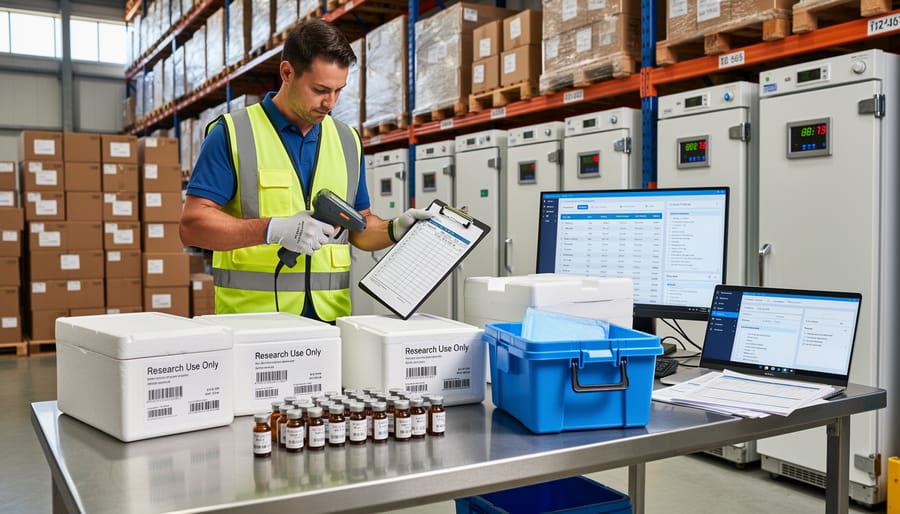
Consider a scenario that plays out regularly in Canadian life sciences: a small distributor imports a vial labelled “for research use only” and markets it with a wink toward human use. It looks like a grey area, but the regulatory logic is fairly clear. Ipamorelin is not an approved therapeutic product in Canada. Health Canada treats drugs, natural health products and genuine research materials under different frameworks, and a compound sold with implied human benefits can be pulled into the drug framework regardless of what the label says.
That ambiguity is exactly where the supply chain gets risky. “Research use only” products are not held to the manufacturing and purity standards expected of authorized drugs, so buyers have little assurance about identity, concentration or contaminants. For executives, this is a matter of reputation and compliance as much as science, since a supplier’s loose claims can become a distributor’s liability.
Athletes face a separate issue. Growth hormone secretagogues are generally prohibited under anti-doping rules, so interest in the peptide carries real eligibility consequences for competitors.
Ethical responsibility is shared. Suppliers should avoid implied health claims, labs should document provenance, and media should resist hype that outruns early-stage evidence. Forward-looking innovation in life sciences depends on that discipline.
A useful next step for any reader is an interview-style conversation with a Canadian regulatory-affairs or compounding-pharmacy specialist, who can explain how these categories are interpreted in practice. For definitive guidance, consult Health Canada’s official resources and qualified professionals rather than relying on supplier marketing.
Common Questions About Ipamorelin
Readers tend to arrive with the same handful of questions, so here are direct, evidence-aware answers to the most common ones.
Is ipamorelin a hormone or a peptide?
It is a synthetic peptide, a short chain of five amino acids. It is not a hormone itself; it is designed to prompt the pituitary gland to release growth hormone, which is the actual hormone.
Is ipamorelin approved by Health Canada?
No. It is not an authorized therapeutic product in Canada, and material sold as “research use only” sits outside the oversight that applies to approved drugs. Confirm current status directly with Health Canada.
How does it differ from human growth hormone?
Human growth hormone is administered directly, whereas ipamorelin acts upstream by stimulating the body’s own pulsatile release. That distinction is mechanistic and does not imply equivalent outcomes or safety.
What does the research actually show?
Most findings come from preclinical studies and early-stage clinical work, including research on post-operative gastrointestinal recovery. The evidence base is limited and should not be read as proof of therapeutic benefit.
Two further questions come up often among business and athletic audiences. On competitive sport, growth hormone secretagogues are generally treated as prohibited substances under anti-doping frameworks, so athletes should check the current World Anti-Doping Agency prohibited list and consult the Canadian Centre for Ethics in Sport before assuming anything is permitted.
On quality and sourcing, researchers should look for suppliers that provide independent certificates of analysis, transparent batch testing and documented purity, and should be wary of vendors who make health claims. For regulatory questions, official Health Canada resources and qualified professionals, such as regulatory-affairs specialists or pharmacists, remain the most reliable guides. None of this is medical advice, and nothing here should be taken as a recommendation to use the peptide.
Ipamorelin is a synthetic pentapeptide that mimics ghrelin signalling, prompting the pituitary to release growth hormone in a pulsatile pattern. Researchers value its selectivity, but most of what we know comes from preclinical work and a small number of early clinical studies. That is a long way from established therapy, and the gap matters.
For Canadian business and life-sciences leaders, the practical takeaways are straightforward. Ipamorelin is not an approved therapeutic product here, and the “research use only” market remains inconsistent on purity, labelling and traceability. Organizations that handle research materials should insist on documented quality standards, independent testing and clear compliance with Health Canada’s framework.
Peptide science will keep drawing investment, and it fits squarely within the broader push for national innovation. The companies that earn trust will be those that pair curiosity with rigour: transparent sourcing, honest claims and respect for the evidence as it stands. Always consult official Health Canada sources and qualified professionals before drawing conclusions.