

For Canadian businesses, climate change is no longer a sustainability side project. It’s a strategy question that touches disclosure, supply chains, product lines, and access to capital. The companies that treat it that way, and act on verified policy signals rather than guesswork, will be better placed than those waiting for every rule to be finalized.
The direction of travel is already clear. Ottawa has framed the transition around four building blocks: Build, Switch, Transform, and Innovate. It has committed to net-zero emissions in its own operations by 2050, announced $2 billion to deliver one million home retrofits, and renewed its international climate finance goal of $13 billion in support over five years. Those are signals about where public money and procurement attention are heading.
Disclosure is where the pressure lands most directly on corporate leaders. Canadian regulators are consulting widely on corporate climate reporting, and proposed guidance from the Canadian Sustainability Standards Board would require companies to report Scope 1, Scope 2, and Scope 3 emissions, including upstream supply chain emissions or the end use of products. Scope 3 is the hard part. It reaches beyond your own walls and into the data your suppliers and customers hold.
There’s a commercial upside too. More than half of the 108 large Canadian companies surveyed already sell at least some products or services that help clients cut greenhouse-gas emissions. Climate risk, in other words, is also a market.
This article looks at what these shifts mean in practice, how Canadian peers are responding, and where the ethical lines sit between genuine progress and window dressing.
Where Canada’s Policy Framework Is Pointing Business
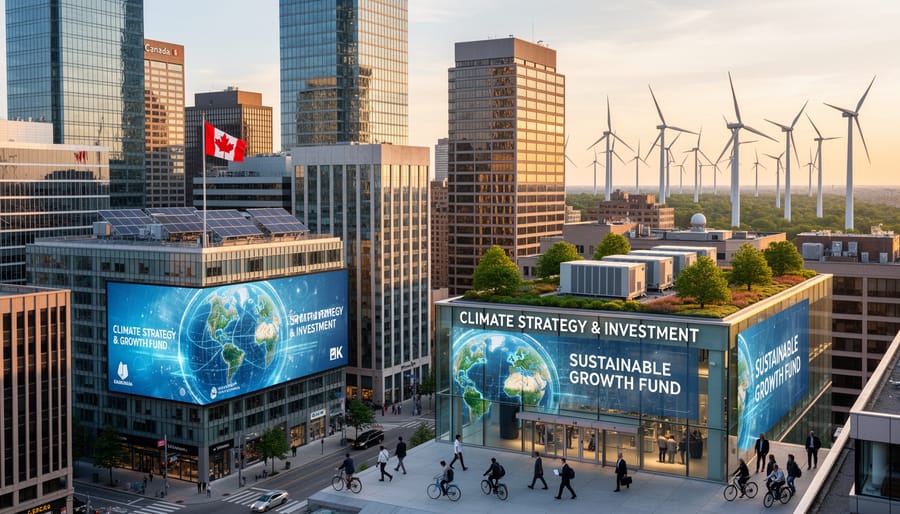
Reading the Signals: Net-Zero Ambitions and What They Mean for the Private Sector
When Ottawa commits to net-zero in government operations by 2050 the headline is about the public service. The business implication is quieter, and arguably more important. Government is a buyer, and what a buyer commits to eventually shapes what it asks of its suppliers.
If you sell to government, partner with it, or sit several tiers down its supply chain, that is the signal worth reading. Operations that must reach net-zero will rely on the goods, services, buildings and logistics they purchase. Over time, it is reasonable to expect emissions performance to matter more in how those partnerships are evaluated. That is an inference about direction, not a published rule, and leaders should treat it that way.
What the commitment does not give you is a timeline, a set of supplier requirements, or any promise about how procurement criteria will change. Nothing in the verified record says otherwise, so planning should not assume it.
Still, the practical move is clear. Know your own emissions profile before a customer asks for it. Understand where your products sit in a government buyer’s footprint. Companies that can answer those questions early will be easier to buy from later.
Incentives and Funding Already on the Table

Policy direction only matters to a business if money and demand follow it, and two commitments already do.
The first is a $2 billion retrofit investment to deliver one million home retrofits across Canada. For contractors, energy-services firms and materials suppliers, that is a pipeline signal. Retrofit work pulls through insulation, heat pumps, windows, energy audits and skilled labour, and it favours companies that can scale installation and quality assurance rather than just sell product. The announcement doesn’t spell out eligibility for private firms, so treat it as a planning input, not a guaranteed contract. The sensible move is to track how the program is delivered and to line up capacity, training and supplier relationships before the work arrives.
The second is international. Canada is one of the first developed countries to renew its climate finance commitment, with a goal of delivering $13 billion over five years in climate-related support. Companies with expertise in clean technology, engineering, advisory or project delivery may find openings in the programs that carry this money abroad, though the pathways will vary and aren’t detailed here.
The practical takeaway is to map your products, skills and workforce against these two streams now. Confirm the specifics with the relevant program owners before building any revenue assumptions on them.
The Disclosure Shift: Scope 1, 2 and 3 Reporting Comes Into Focus

Why Scope 3 Is the Hard Part
Scope 1 and 2 emissions sit inside your own walls, so most companies can measure them with utility bills and fuel records. Scope 3 is different. Under proposed Scope 1, 2 and 3 reporting companies would have to account for emissions from their upstream supply chains and from the end use of their products. That means counting carbon you don’t directly control.
The first obstacle is data. Suppliers often don’t track their own emissions, and the ones who do may use methods that don’t line up with yours. Product end-use is harder still, because it depends on how customers behave long after the sale.
The second obstacle is ownership. Scope 3 doesn’t belong to one department. Procurement holds supplier relationships, finance holds the reporting discipline, operations understands the processes, and sales knows how products are used. When no one is accountable across all four, the numbers stall.
You can start before the guidance is final:
– Map your suppliers by spend and by likely emissions intensity, then focus on the top tier rather than chasing everyone at once.
– Add emissions data requests to contract renewals and onboarding, so cooperation becomes routine instead of a special favour.
– Name one executive owner and build a working group that pulls in procurement, finance, operations and product teams.
– Use estimates where primary data is missing, document your assumptions, and plan to replace them with supplier-specific figures over time.
A rough, well-documented baseline beats a perfect one that never gets built.
Preparing Without Waiting for Final Rules
Canadian regulators are consulting widely on corporate climate disclosure, and proposed guidance from the Canadian Sustainability Standards Board would require Scope 1, 2 and 3 reporting. Final rules aren’t settled, but the direction is clear enough to start building capability now. Waiting for certainty usually means scrambling later, and a rushed first disclosure is where weak claims creep in.
Here’s a practical sequence to work through:
- Set an emissions baseline for Scope 1 and 2 first, using your own fuel, facilities, and purchased energy data, and document the method so it can be repeated.
- Map your upstream supply chain and the end use of your products to see where Scope 3 emissions are likely to concentrate.
- Assign a named owner for emissions data, and bring finance, procurement, and operations into one shared process instead of leaving it with sustainability alone.
- Build or upgrade data systems so inputs are traceable, with an audit trail from source records to reported numbers.
- Open conversations with your largest suppliers about what data they can share and in what format.
- Brief the board on a regular schedule, so oversight is established before any rule requires it.
Throughout, treat every public claim as something you may need to defend. State what you measured, how you measured it, and what remains estimated. If a figure rests on proxies or incomplete supplier data, say so plainly. That discipline protects credibility, and it makes the eventual shift to formal reporting far less painful.
Climate Solutions as a Growth Engine
Here is a signal worth watching: more than half of the 108 large Canadian companies surveyed say they sell at least some products or services that help clients reduce greenhouse-gas emissions. Climate action, in other words, is no longer only a cost center or a compliance exercise. For a growing share of large firms, it is a line of business.
That matters for how we think about industry leadership. When a company moves from asking “how do we cut our own footprint?” to “what can we sell that cuts someone else’s?”, climate strategy stops being a side project and starts shaping the core revenue model. The offering might be an energy-efficiency service, a low-emissions material, or a software platform that helps customers measure and manage their own output. Each of these ties the company’s growth to its clients’ decarbonization, which is a very different incentive than reputation management alone.
Technology-enabled solutions sit at the center of this shift. Data platforms, monitoring tools and analytics let companies verify the emissions reductions they claim to deliver, and that verification is quickly becoming the price of entry. It is also where innovation pays off. Buyers facing their own disclosure pressures, including the proposed Scope 3 reporting guidance, will gravitate toward suppliers who can document results rather than simply assert them. Careful, defensible claims about what your products actually achieve are how you protect your reputation while you grow in this space.
A caution, though. The survey is a snapshot of large Canadian companies, and it should not be read as a portrait of the whole economy. Smaller and mid-sized firms may face different constraints, from limited capital to thinner technical capacity, and their experience could look quite different. Treat the figure as evidence that the market is real and maturing, not as proof that every Canadian business has already made the leap.
For leaders, the practical question is a simple one. Where in your portfolio do customers already have a emissions problem you could help solve, and do you have the data to prove you are solving it?
Putting Climate Strategy Into Practice Inside a Canadian Company
A useful test for any climate plan is whether it treats emissions as an operating problem before it becomes a reporting problem. The companies making real progress tend to follow a similar path, and each step is one a leadership team can check against its own business.
It starts with the business problem. For most firms the exposure is concrete: a supply chain that accounts for most of the company’s emissions, energy costs that swing with volatile inputs, or customers who now ask for emissions data in tenders. Naming that exposure in operational terms, rather than slogans, is what turns a sustainability goal into a strategy.
Next comes the choice of moves. Ottawa’s four building blocks work as a practical menu: a company can build new low-carbon capacity, switch fuels or suppliers, transform a process, or innovate a product. If the business already sells products that help clients cut emissions, as more than half of the 108 large Canadian companies surveyed do, the question is how to move that offering from side line to core revenue. Where technology carries the plan, the broader story of technology innovation reshaping Canadian industry shows where a company can fit.
The operational and financial side deserves candor. A credible plan sets out what the transition requires in capital, staffing and data systems, how the finance team judges payback, and which trade-offs it is prepared to accept. Scope 3 measurement is usually the hardest thread: proposed guidance from the Canadian Sustainability Standards Board would require reporting on upstream supply chain and end-use emissions, so supplier relationships and data pipelines are worth building well before any rule is final.
Stakeholder and community impact is where many plans go thin. Workers, local communities and Indigenous partners should be consulted early, with a clear record of what changed for them and what the company heard back. Smaller or founder-led firms may find the lessons of how to transform ventures into durable enterprises useful here, and it helps to see where a plan sits within the Canadian tech pillars that support national innovation. For resource and food businesses, the lens of agriculture innovation may fit better.
Finally, the lessons a company draws should read as decisions rather than praise: what it would repeat, what it would change, and what it still has not resolved. A net-zero target carries weight only when it is backed by that kind of operational detail.
The Questions Executives Are Weighing
For Canadian business leaders, climate risk and opportunity now shape the decisions that define industry leadership. Four questions come up again and again.
First, capital allocation. How should long-term climate exposure be weighed against near-term returns, and what role should policy signals such as Canada’s four building blocks (Build, Switch, Transform, Innovate) play in that thinking? Leaders who handle this well know exactly where climate considerations enter the investment process, and who owns that call.
Second, disclosure readiness. With regulators consulting on corporate climate disclosure and the Canadian Sustainability Standards Board’s proposed guidance pointing toward Scope 1, 2 and 3 reporting, the useful question is what the organization is doing now. In practice that means the finance team working with operations and procurement to gather the data before it is required.
Third, talent and stakeholder trust. Climate commitments can affect recruitment, retention and investor confidence, but only if the claims behind them hold up as scrutiny rises. The discipline is to keep every claim defensible and to avoid overpromising to customers and communities.
Fourth, opportunity. With more than half of 108 surveyed large Canadian companies already selling products or services that help clients cut emissions, every executive should be asking where their own sector is heading, and which technology-enabled solutions are moving from pilot to core revenue.
Underneath all four sits the ethical dimension: workers in carbon-intensive regions, Indigenous partnership, and the tension between competitiveness and responsibility.
The Ethical Dimension: Credibility, Communities and a Fair Transition

Credibility is the real asset in any climate strategy, and it erodes faster than it builds. The most common ethical failure is overstating progress. If a company can’t back a claim with measured data, it shouldn’t make it. Canadian regulators are consulting this year on corporate climate disclosures, and proposed guidance would require reporting of Scope 1, 2 and 3 emissions. Honest disclosure, including the uncomfortable numbers, protects a business long before any rule becomes final.
Workers and communities deserve the same rigour. A shift toward lower emissions lands unevenly, and carbon-intensive regions often feel it first. Leaders should ask who gains and who bears the cost, then plan for retraining, redeployment and transparent timelines rather than announcing a direction and leaving people to guess. A transition that quietly shifts the burden onto a single town is hard to defend, and hard to sustain.
Indigenous partnership belongs in the planning stage, not the notification stage. Consultation that begins after a project is designed tends to produce delay and distrust. Early engagement, shared decision-making where appropriate, and a willingness to change the plan in response to what you hear are what separate genuine partnership from a box-ticking exercise.
Then there is the tension every Canadian executive recognizes: staying competitive while meeting environmental responsibility. The two aren’t always aligned in the short term, and pretending otherwise invites cynicism. The practical answer is to be explicit about trade-offs, set targets you can verify, and build capability that holds up under scrutiny. That discipline matters for any organization, whether it is a startup working to scale from idea to enterprise or an established firm rethinking its supply chain. Trust, once earned, becomes a competitive advantage of its own.
Questions Canadian Leaders Are Asking About Climate and Business
Is the climate disclosure guidance final?
No. Canadian regulators are consulting widely this year on corporate climate disclosures, and the Canadian Sustainability Standards Board’s guidance is still proposed. Treat it as a strong directional signal, not a settled rulebook.
What does Scope 3 mean for a mid-sized company?
Under the proposed guidance, companies would report Scope 3 emissions from their upstream supply chains or the end use of their products. For a mid-sized firm, that means knowing which suppliers and product uses drive the most emissions, even before any final requirement lands.
Can climate solutions actually generate revenue?
More than half of the 108 large Canadian companies surveyed said they sell at least some products or services that help clients reduce greenhouse-gas emissions. That is a snapshot of large firms, so it shouldn’t be read as a promise for every business.
Where should we start on readiness?
Begin with a baseline measurement of your emissions and a clear picture of who owns the data internally. Federal signals, including the $2 billion investment toward one million home retrofits, point to where demand and funding are heading, though eligibility details should be confirmed directly with program administrators.
None of these answers requires a final rule to be useful. The unresolved pieces, including how any given company will set its own net-zero targets, are decisions each organization still has to make for itself. What you can do today is get your data in order, understand your supply chain, and keep a close eye on how the consultations settle.
Climate strategy and business leadership are no longer separate conversations in Canada. The policy direction is already visible: the federal government is committed to net-zero emissions in its own operations by 2050, and its Build, Switch, Transform and Innovate framework tells planners where public effort and capital are heading. Disclosure expectations are tightening too. With regulators consulting on proposed guidance that would require Scope 1, 2 and 3 reporting, companies that start measuring now will face fewer surprises later.
The market is moving as well. More than half of the 108 large Canadian companies surveyed already sell something that helps clients cut emissions, which suggests climate solutions are becoming part of core revenue strategy.
So act on what’s clear. Build your emissions baseline, engage your suppliers, and give your board real oversight. Then stay flexible on what’s still evolving, because the final rules and timelines aren’t settled. Leaders who do both will be best placed to compete and to earn trust.