
Canada’s cannabis vaping sector is undergoing a fundamental transformation as next-generation cannabinoids like tetrahydrocannabiphorol (THCp) enter commercial production and new delivery technologies reshape product development timelines. THCP vapes represent the cutting edge of this evolution, combining molecular innovation with advanced vaporization systems that deliver potency levels far exceeding conventional THC formulations.
For corporate strategists and business leaders navigating Canada’s regulated cannabis market, understanding these trends isn’t academic. The vaping category now accounts for roughly one-quarter of legal cannabis sales nationally, and the introduction of novel cannabinoids is forcing companies to rethink everything from supply chain partnerships to quality assurance protocols. This shift mirrors broader patterns in agriculture innovation where scientific precision and controlled environments drive competitive advantage.
The stakes are considerable. Health Canada’s evolving regulatory framework continues to shape product viability, while consumer expectations around transparency, sustainability, and performance intensify. Companies that treated vaping as a simple product line extension are now confronting a market that demands expertise in extraction chemistry, hardware engineering, and environmental stewardship simultaneously.
This analysis examines how THCp vaping products function at a technical level, identifies the distinct product categories emerging in Canadian retail channels, and outlines the regulatory and sustainability considerations that separate market leaders from followers. Drawing on the same innovation playbook that guides successful agtech ventures, forward-thinking cannabis executives are positioning vape technology as a platform for differentiation rather than a commodity offering.
What THCp Is and Why It Matters to the Canadian Cannabis Industry
Tetrahydrocannabiphorol, known as THCp, is a cannabinoid discovered in 2019 during Italian research into cannabis plant chemistry. Unlike the more familiar delta-9-THC, THCp features a seven-carbon alkyl side chain, two carbons longer than THC’s five-carbon structure. That molecular difference matters. The extended chain allows THCp to bind more effectively to the body’s CB1 receptors, which are concentrated in the brain and central nervous system. Early preclinical studies suggest this enhanced binding affinity may produce more pronounced effects at lower doses, though human research remains limited.
- THCp
- A naturally occurring cannabinoid with a seven-carbon alkyl side chain, offering stronger CB1 receptor binding than standard THC.
- CB1 receptor affinity
- The degree to which a cannabinoid molecule binds to CB1 receptors in the brain and nervous system, influencing the intensity and character of effects.
- Alkyl side chain
- A carbon-hydrogen molecular tail attached to the cannabinoid structure; THCp’s seven-carbon chain is longer than THC’s five-carbon version, enhancing receptor interaction.
- Cannabinoid profile
- The complete spectrum of cannabinoids present in a cannabis product, which collectively determine its therapeutic and experiential characteristics.
For Canadian licensed producers, THCp represents both an opportunity and a strategic question. Health Canada regulates it under the Cannabis Act’s existing framework, treating it as a novel cannabinoid subject to the same testing, labeling, and potency disclosure requirements as THC and CBD. A handful of LPs have introduced THCp-dominant vape products since late 2024, positioning them in the premium segment with higher price points that reflect extraction complexity and limited supply. The business case hinges on differentiation in a crowded market where standard THC vapes face margin compression. Companies exploring THCp formulations are investing in consumer education to explain the potency difference, manage expectations around dosing, and avoid the reputational risk of products that overwhelm inexperienced users. As analytical labs refine testing protocols and more producers scale up THCp extraction, the cannabinoid’s role in Canada’s vape category will depend on balancing innovation with responsible market introduction.
How THCp Vape Products Work in Practice
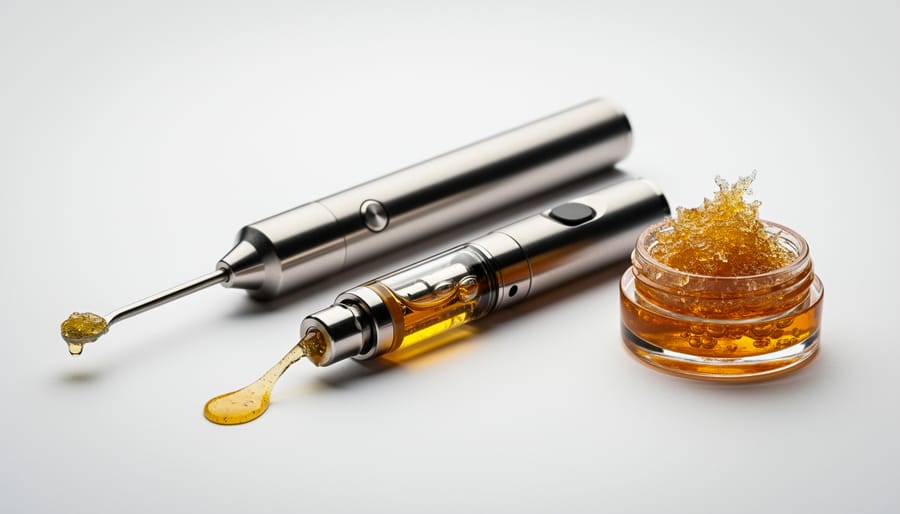
THCp vape products deliver cannabinoids through a controlled heating process that vaporizes concentrated extracts without combustion. When a user inhales from a cartridge or disposable, the battery activates a ceramic or metal coil housed in the atomizer, heating the THCp concentrate to temperatures typically between 315°F and 400°F. At this range, the cannabinoid distillate or live resin transforms into an aerosol that carries THCp molecules into the lungs, where they cross into the bloodstream through the alveolar membrane.
The hardware architecture of THCp vapes comprises several integrated components working in sequence:
- Battery: Lithium-ion cell providing regulated voltage (usually 3.2V to 4.2V) to power the heating element
- Atomizer: Heating chamber containing a coil wrapped around a ceramic core or wick material that vaporizes the concentrate
- Wick or absorption system: Porous material (cotton, ceramic, or quartz) that draws liquid concentrate from the reservoir to the heating coil through capillary action
- Mouthpiece: Airflow channel designed to cool vapor slightly before inhalation and prevent oil leakback
- Reservoir: Chamber holding 0.5mL to 1mL of THCp concentrate, typically constructed from borosilicate glass or medical-grade PCTG plastic
Licensed producers formulate THCp concentrates by dissolving purified cannabinoid isolate or full-spectrum extract into carrier oils that maintain proper viscosity for wick saturation. The most common carriers are medium-chain triglyceride (MCT) oil, propylene glycol, or vegetable glycerin, though some premium formulations use terpene-only dilution to preserve flavor profiles and entourage effects. The carrier must keep the concentrate fluid enough to flow through the wick while preventing separation or crystallization during storage.
Vaporized THCp enters the bloodstream within two to five minutes of inhalation, delivering faster onset than edibles (45 to 90 minutes) or capsules. Peak plasma concentration occurs around 10 minutes post-inhalation, with noticeable effects lasting two to four hours depending on dosage and individual metabolism. This rapid bioavailability stems from the lungs’ large surface area and rich capillary networks, which absorb cannabinoids directly without first-pass liver metabolism. For corporate strategists evaluating product formats, this pharmacokinetic profile positions vapes as the preferred option for consumers seeking immediate effect control and dose titration, particularly relevant given THCp’s reported higher potency compared to delta-9 THC.
Categories of THCp Vape Products Entering the Canadian Market
510-Thread Cartridges
The 510-thread cartridge format has emerged as the dominant delivery mechanism for THCp concentrates in Canada’s regulated market, largely due to its universal compatibility with existing battery hardware. Named for the 10 threads at 5mm diameter on the connector, this standardized design allows consumers to use a single rechargeable battery across multiple cartridge purchases from different licensed producers. This interoperability reduces the total cost of ownership for consumers and eliminates redundant battery waste with each product purchase.
Licensed producers favor the 510-thread approach for THCp formulations because it separates the consumable concentrate from the reusable power source, creating a more cost-effective manufacturing and distribution model. The modular design allows LPs to invest in high-quality cartridge components, ceramic coils, medical-grade glass tanks, and lead-free solder connections, without absorbing the expense of integrated battery systems. For THCp specifically, where precise temperature control affects cannabinoid stability and flavor preservation, premium cartridge hardware becomes a quality differentiator that justifies higher price points while maintaining margin flexibility.
The format also streamlines regulatory compliance, as cartridges undergo separate testing protocols from batteries and can be more easily recalled or reformulated without affecting the hardware ecosystem.
All-in-One Disposables
All-in-one disposable THCp vapes have captured significant retail shelf space in Canada’s legal market despite their premium positioning. These self-contained units arrive pre-charged and pre-filled, eliminating the need for separate batteries or technical knowledge, a plug-and-play proposition that appeals to consumers prioritizing discretion and portability. Licensed producers typically price disposables 20-30% higher per milligram of THCp than equivalent cartridge formats, justifying the premium through convenience and consistent performance across the product’s lifespan.
However, this convenience comes with substantial environmental costs that complicate corporate sustainability commitments. Each disposable contains a lithium-ion battery, circuit board, and plastic housing designed for single use, creating a mixed-material waste stream that exceeds municipal recycling capabilities. With THCp disposables often depleted within 100-150 inhalations, the volume of electronic waste generated per gram of cannabinoid consumed is considerably higher than reusable systems.
Forward-thinking licensed producers are exploring Extended Producer Responsibility frameworks and in-store take-back programs, recognizing that regulatory pressure around single-use vape waste will likely intensify as the category matures. Balancing consumer demand for hassle-free THCp products against environmental accountability represents a critical strategic tension for industry leaders.
Applications and Market Positioning for THCp Vapes
Licensed producers are treating THCp vapes as a strategic differentiation tool in a mature category where conventional THC cartridges have become commoditized. These products typically enter the market at premium price points, often 30 to 50 percent above standard distillate cartridges, reflecting both novelty positioning and higher per-milligram production costs. The target demographic skews toward experienced cannabis consumers who actively seek novel cannabinoid profiles and are less price-sensitive than entry-level buyers. Retailers report that THCp vapes attract connoisseur segments willing to pay for perceived enhanced potency and unique effect profiles, creating margin opportunities that offset slower inventory turnover compared to mass-market SKUs.
Branding strategies diverge along medicinal and recreational lines. Some licensed producers emphasize therapeutic exploration, framing THCp as a cannabinoid of interest for pain management or sleep support in marketing materials aimed at medical authorization holders. Others lean into recreational positioning with craft-focused branding, limited releases, and collaborations with extract artists to signal exclusivity. Both approaches navigate Health Canada’s strict promotional constraints by relying on point-of-sale education through budtenders and discreet packaging cues that signal premium status without making health claims.
Microdosing represents an emerging use case given THCp’s reported potency. Forward-thinking producers are developing lower-concentration cartridges (0.3 to 0.5 mg THCp per inhalation) marketed for controlled daytime use, contrasting with the high-dose recreational positioning of early market entrants. This bifurcation creates two distinct pricing tiers: microdose-oriented products priced competitively with premium CBD or low-THC offerings, and full-strength THCp cartridges positioned as luxury experiences. The margin structure favors the latter, with wholesale-to-retail markups reaching 100 percent in some provincial markets, though competition is compressing these spreads as more producers enter the segment.
Regulatory and Compliance Landscape for Novel Cannabinoid Vapes
THCp vape products fall under Health Canada’s existing regulatory framework for cannabis extracts, meaning licensed producers must navigate the same core requirements that govern all vaporizable concentrates under the Cannabis Act and Cannabis Regulations. However, the novel nature of THCp introduces specific compliance challenges around classification, potency measurement, and consumer communication that are forcing regulatory adaptation in real time.
From a testing and labeling standpoint, THCp is currently treated as a cannabinoid that contributes to total THC content for regulatory purposes. Licensed producers must submit THCp-containing products for third-party testing that quantifies all cannabinoids present, including THCp, delta-9 THC, THCA, and other analogues. Health Canada requires this data to calculate THC equivalency for package labeling, but the agency has not yet issued specific guidance on whether THCp’s reported higher potency warrants adjusted equivalency factors. Until that clarity arrives, most LPs are conservatively applying standard THC conversion ratios and relying on supplementary product information to communicate potency differences to retailers and consumers.
Compliance requirements create multiple touchpoints for corporate risk management:
- Mandatory analytical testing for cannabinoid profiles, residual solvents, pesticides, microbial contaminants, and heavy metals before market release
- Standardized packaging and labeling that includes total THC in milligrams, THC concentration as a percentage, and a health warning occupying at least 25% of the principal display panel
- Lot tracking and serialization through Health Canada’s Cannabis Tracking and Licensing System to enable full supply chain traceability
- Provincial variations in product approval timelines, with some jurisdictions requiring additional review periods for novel cannabinoid formulations before retail listing
- Restrictions on health claims, therapeutic benefit statements, and descriptors that could appeal to youth or suggest enhanced effects
Provincial retail regulations add another compliance layer. Ontario’s AGCO and British Columbia’s LDB, for example, maintain independent product review processes that can delay market access by weeks or months, particularly when a cannabinoid profile deviates from established norms. Alberta’s regulatory environment tends to move faster, but licensed producers still face variability in how quickly THCp vapes reach store shelves across regions.
Industry stakeholders are closely watching Health Canada’s ongoing consultation on novel cannabinoids, which could result in revised testing protocols or differentiated labeling requirements for compounds like THCp. Until those rules solidify, the vaping market economics for THCp products hinge on navigating regulatory ambiguity while maintaining full compliance with existing extract regulations, a balancing act that demands legal diligence and agile product development strategies.
Environmental and Waste Management Considerations
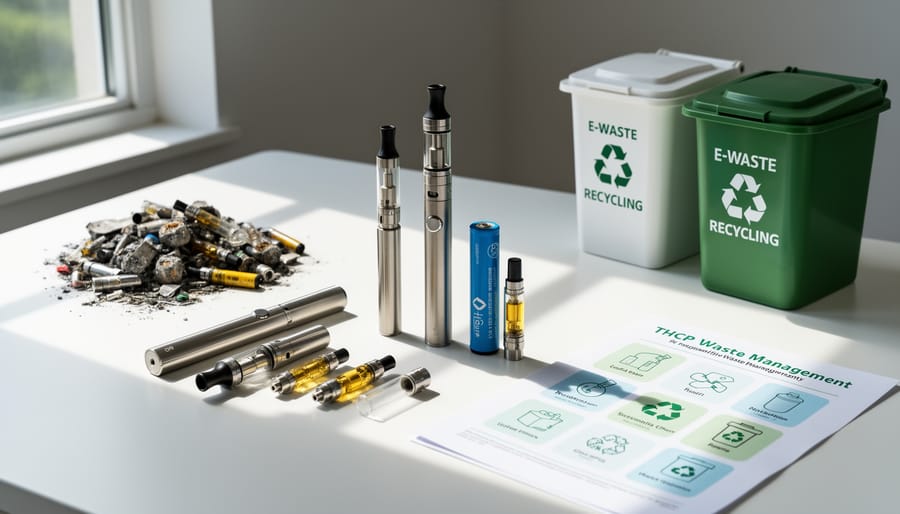
THCp vape products carry a substantial environmental burden that Canadian licensed producers can no longer ignore. A single disposable unit contains a lithium-ion battery, plastic housing, a metal heating element, and residual cannabis concentrate, all of which require specialized disposal pathways that barely exist in most provinces. Standard municipal recycling programs reject cannabis hardware due to contamination concerns, pushing hundreds of thousands of units annually into landfills where batteries can leach heavy metals and plastics fragment into microparticles.
Canada’s cannabis sector currently lacks cohesive recycling infrastructure. While British Columbia piloted a cannabis packaging stewardship program in 2022, vape hardware sat outside its scope. Ontario’s regulations require producers to minimize packaging waste, yet provide no collection mechanism for post-consumer devices. This regulatory vacuum leaves corporate responsibility undefined, even as consumer awareness around single-use electronics grows and investors scrutinize ESG performance.
Extended Producer Responsibility frameworks are emerging as the likely regulatory solution. Alberta’s EPR consultation in 2025 signaled that vape batteries and cartridges will join electronics stewardship programs by 2027, obligating producers to fund collection and processing. Quebec is drafting similar provisions. Forward-thinking LPs are preempting mandates by partnering with specialist recyclers to establish voluntary take-back systems at retail locations, recovering lithium for battery manufacturers and separating plastic and metal components for reprocessing.
Hardware innovation offers another path. Several producers now offer rechargeable 510-thread systems for THCp cartridges, eliminating battery waste with each use. One Ontario LP switched to bio-based plastics for cartridge bodies, cutting petroleum dependence by 60 percent. Another piloted a closed-loop program where returned cartridges are sterilized, refilled, and resold at a discount, an approach that aligns with bioenterprise trends emphasizing circular economy models. These initiatives require upfront capital and consumer education, but they differentiate brands in a commoditizing market while building regulatory goodwill ahead of mandated EPR rollouts.
Industry Adoption Patterns and Market Data
As of mid-2026, THCp vape adoption in Canada remains concentrated among a handful of mid-tier licensed producers testing premium product lines, with no dominant market leader yet established. Early entrants have approached the segment cautiously, releasing limited SKU runs through select provincial retail channels to gauge consumer response before committing to scaled production. Provincial sales data from Ontario and British Columbia, the two largest adult-use markets, indicate THCp cartridges and disposables currently represent less than one percent of total vape category revenue, though velocity metrics show month-over-month growth rates between 15 and 22 percent in stores that carry the products.
Price elasticity testing by several LPs suggests a narrow consumer base willing to pay the 30 to 40 percent premium THCp products command over comparable THC vape offerings. This pricing tier positions THCp alongside live resin and strain-specific craft formulations rather than mass-market distillate cartridges. Competitive dynamics remain fluid: licensed producers with existing extraction infrastructure and terpene libraries hold cost advantages, while newer entrants partnering with contract manufacturers face longer lead times and tighter margin constraints.
Industry analysts project the THCp vape category could reach three to five percent of the broader vape segment by 2028, contingent on sustained regulatory clarity and consumer education investments. Category maturation timelines hinge on whether early adopters expand beyond experienced-consumer niches into broader recreational demographics, a shift that will require refined dosing guidance and clearer effect-profile messaging.
Supply chain considerations present notable barriers. Raw THCp sourcing relies on specialized extraction techniques or synthetic cannabinoid pathways, both capital-intensive and subject to batch-to-batch variability. Manufacturing partnerships with hardware suppliers capable of handling high-potency concentrates remain limited, and quality control protocols demand more rigorous residual solvent and heavy metal testing than standard THC products. These factors echo challenges seen across Canadian agrifood innovation where novel ingredient commercialization requires coordinated investment in upstream processing and downstream compliance infrastructure before market viability is proven.
Frequently Asked Questions
How does THCp potency translate to product dosing recommendations?
THCp’s higher CB1 receptor affinity means licensed producers typically formulate cartridges at lower cannabinoid concentrations than traditional THC products, often blending THCp with CBD or CBG to moderate intensity. Most commercially available THCp vapes in Canada contain between 10-30% THCp by volume, with recommended single inhalations starting at one to two seconds for inexperienced users.
What liability considerations should operators account for with THCp products?
Liability exposure centers on adequate consumer warnings about potency, clear dosing guidance on packaging, and employee training to prevent inappropriate recommendations to vulnerable populations. Operators should review their product liability insurance policies to confirm coverage extends to novel cannabinoids and document all quality control protocols for batch consistency.
How do retail margins compare to traditional THC vapes?
THCp vape products currently command 15-25% higher wholesale prices than equivalent-format THC cartridges, with retail margins often 2-4 percentage points higher due to premium positioning. However, slower inventory turnover in some markets can offset margin advantages, making per-square-foot profitability comparable to high-volume standard vape SKUs.
Are there intellectual property considerations around THCp formulations?
While THCp itself is a naturally occurring compound and cannot be patented, specific extraction methods, formulation ratios, and delivery system designs may be protectable. Several Canadian LPs have filed patent applications covering proprietary blend compositions and stability-enhancing carrier systems for THCp concentrates.
Beyond these operational fundamentals, effective consumer education has emerged as a competitive differentiator. Leading retailers are implementing point-of-sale training modules that equip budtenders to explain THCp’s molecular distinctions without making therapeutic claims, using visual aids that compare relative potency to familiar products. Some licensed producers have developed QR-linked video content embedded in packaging, walking first-time users through proper inhalation techniques and encouraging wait periods between doses. These educational investments reduce product returns, minimize adverse experience reports, and build brand loyalty in a category where trust determines repeat purchase behavior. Corporate strategy should allocate resources not just to product development but to the communication infrastructure that supports responsible market entry.
THCp vape products represent a pivotal development in Canada’s cannabis sector, pushing licensed producers into uncharted territory where potency innovation meets evolving regulatory frameworks. Corporate leaders who navigate this space successfully will balance aggressive market positioning with rigorous compliance protocols, ensuring product claims align with Health Canada’s testing requirements and labeling standards.
The environmental dimension cannot be treated as an afterthought. Single-use disposables and cartridge waste pose reputational and regulatory risks that forward-thinking companies are addressing through take-back programs, recyclable hardware investments, and transparent lifecycle impact reporting. These sustainability commitments differentiate brands in a crowded market while anticipating stricter Extended Producer Responsibility mandates.
Positioning your organization at this convergence requires simultaneous attention to three fronts: understanding consumer demand for novel cannabinoid experiences, maintaining absolute regulatory compliance as THCp classification evolves, and embedding environmental accountability into product development from day one. The licensed producers who achieve this integration will define the next generation of cannabis vaping in Canada, capturing market share while building long-term stakeholder trust in an industry where both innovation velocity and corporate responsibility matter equally.